This post introduces llm-jp-eval-mm, a tool for evaluating the Japanese-language performance of vision-language models, which I am developing together with Silvia as part of the multimodal working group of LLM-jp.
llm-jp-eval-mm
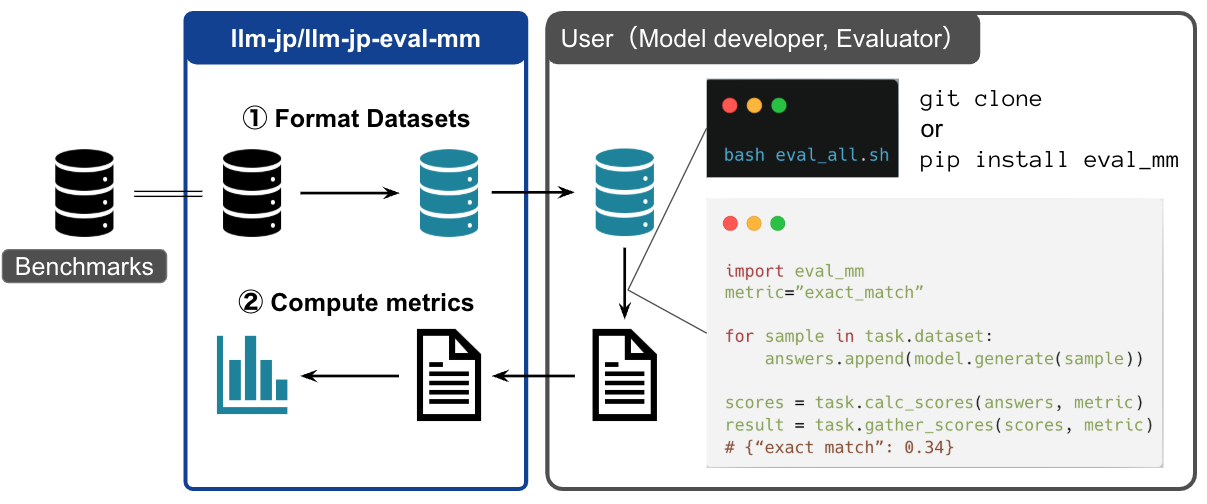
In recent years, many companies and research institutions have been actively developing vision-language models that can handle both text and images. However, benchmarking infrastructure for Japanese has lagged behind that for English, which made it difficult to evaluate these models properly.
llm-jp-eval-mm was developed to address this: it builds on existing Japanese benchmark tasks so that models can be evaluated on a common foundation. The tool is designed to be more lightweight than existing evaluation tools (e.g., lmms-eval), which makes it easy to add new models and benchmark tasks.
Available Tasks
The following tasks are currently available.
Japanese tasks
English tasks
Usage
Installation
The tool uses uv, a modern Python package manager, and you can set up the environment with the following command.
uv syncEvaluation
For example, to evaluate the model llava-hf/llava-1.5-7b-hf on the japanese-heron-bench task, follow these steps.
- Install the required dependencies
uv sync --group normal- Run the evaluation
The following command specifies the model name, task name, evaluation metrics, and so on. Since we evaluate with llm_as_a_judge here, an OpenAI model is specified as the judge model (currently, only the Azure OpenAI API is supported).
uv run --group normal python examples/sample.py \
--model_id llava-hf/llava-1.5-7b-hf \
--task_id japanese-heron-bench  \
--result_dir test  \
--metrics "llm_as_a_judge_heron_bench" \
--judge_model "gpt-4o-2024-05-13" \
--overwrite
Features and Design Choices
Using uv Dependency Groups
Different vision-language models depend on different libraries, so dependency conflicts are common.
The tool uses uv’s dependency groups, so by specifying a group name like this
uv run --group <group name> pythonyou can keep each model’s dependencies properly managed.
Lightweight Design
Evaluating a vision-language model breaks down into three main steps.
- Preparing the evaluation dataset (
Taskclass) - Generating model outputs (
VLMclass) - Computing evaluation scores (
Scorerclass)
Mapping each step to its own class makes the code easier to reuse and to test.
Leaderboard
We publish a leaderboard built with llm-jp-eval-mm on the following website.
https://llm-jp.github.io/llm-jp-eval-mm
(The website was modeled on the JMMMU website. Many thanks to its authors.)
Conclusion
This post introduced llm-jp-eval-mm, a tool for evaluating the Japanese-language performance of vision-language models.
Questions, as well as requests to add new tasks or models, are welcome via GitHub Issues and Pull Requests.
Also, Silvia will present this tool at NLP2025 in Nagasaki (March 2025). Please come by!