Introduction
Vision-Language Models (VLMs), which process two modalities (images and text), have been attracting attention in recent years. Datasets of images paired with their corresponding captions (image-text pair datasets) play an important role in VLM development. For example, CLIP, which trains its model with contrastive learning, uses an image-text pair dataset of about 400M pairs. Given the importance of image-text pair datasets, large-scale ones such as LAION-5B are being actively built.
However, existing datasets are skewed toward languages such as English and Chinese, and Japanese image-text pair datasets are insufficient in both scale and quality.
We therefore built WAON (Web-scale image text Aligned Open Nihongo), a large-scale, high-quality Japanese image-text pair dataset.
Overview of WAON
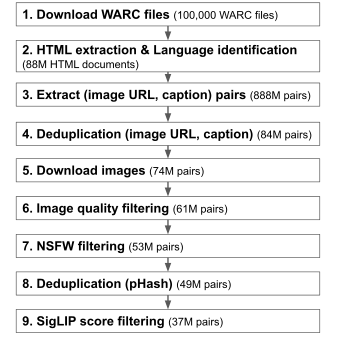
WAON is a Japanese image-text pair dataset consisting of about 155M examples. WAON is built from Japanese web pages collected from Common Crawl, using the following six snapshots: {2025-18, 2025-08, 2024-51, 2024-42, 2024-33, 2024-26}
The data construction pipeline is shown below. To ensure high quality, we carefully performed filtering and deduplication.
Evaluating WAON
One way to evaluate the quality of a training dataset itself is to train a model on it and measure the performance of the resulting model. We evaluated the usefulness of WAON by fine-tuning the multilingual CLIP model google/siglip2-base-patch16-256 on WAON and evaluating it on several benchmarks, including Japanese cultural image classification datasets.
WAON-Bench
The Recruit dataset is an existing Japanese cultural image classification dataset, but it has problems: it contains mislabeled examples, and 101 of its 161 classes belong to the food category, so its category distribution is heavily skewed.
We therefore built WAON-Bench, a new benchmark for Japanese cultural understanding. WAON-Bench consists of 1,870 images in total (8 categories, 374 classes, 5 images per class), and each image is annotated with the correct class label.

Results
The figure below compares Top-1 Accuracy on WAON-Bench when fine-tuning on WAON and on the Japanese subset of ReLAION. Using WAON improves performance efficiently.
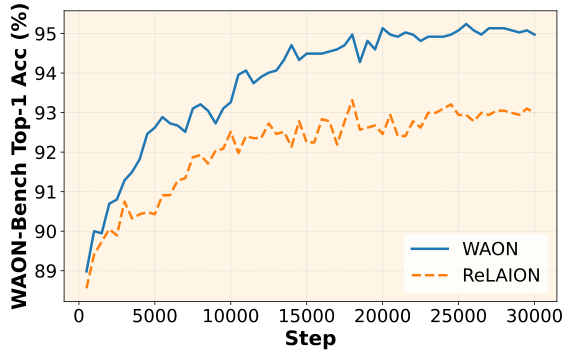
The table below shows the results of each model on several benchmarks. The model fine-tuned on WAON achieves SoTA performance on the Recruit dataset and WAON-Bench. WAON also outperforms the Japanese subset of ReLAION on all benchmarks.
| Model | Params | XM3600 | ImageNet | Recruit | WAON-Bench | Avg |
|---|---|---|---|---|---|---|
| siglip2-base-patch16-256 (fine-tuned on WAON) | 375M | 73.75 | 49.61 | 83.14 | 94.97 | 75.37 |
| siglip2-base-patch16-256 (fine-tuned on ReLAION) | 375M | 72.39 | 47.38 | 81.65 | 92.99 | 73.60 |
| siglip2-base-patch16-256 | 375M | 38.28 | 48.12 | 76.98 | 87.81 | 62.80 |
| clip-japanese-base | 196M | 78.00 | 48.90 | 81.65 | 90.05 | 74.65 |
| siglip-base-patch16-256-mult | 371M | 43.22 | 53.26 | 75.10 | 89.25 | 65.21 |
| Japanese Stable CLIP ViT-L-16 | 414M | 66.03 | 55.97 | 71.29 | 82.03 | 68.83 |
| LAION-CLIP-ViT-H-14 | 1193M | 72.64 | 47.67 | 70.62 | 85.88 | 69.20 |
These results show that WAON is a high-quality Japanese image-text pair dataset that efficiently improves model performance.
Conclusion
In this post, we introduced WAON, a large-scale, high-quality Japanese image-text pair dataset. Our experiments showed that using WAON efficiently improves a model’s understanding of Japanese culture. For details, see our paper, “WAON: Large-Scale Japanese Image-Text Dataset for Cultural Adaptation in Contrastive Vision-Language Models”.
If you are developing a vision-language model, give WAON a try!
Links
- Paper: https://arxiv.org/abs/2510.22276
- WAON: https://huggingface.co/datasets/llm-jp/WAON
- WAON-Bench: https://huggingface.co/datasets/llm-jp/WAON-Bench
- waon-siglip2-base-patch16-256: https://huggingface.co/llm-jp/waon-siglip2-base-patch16-256
- Code: https://github.com/llm-jp/WAON