This post introduces LLM-jp-4-VL-9B-beta, a vision-language model developed by LLM-jp.
Starting from llm-jp/llm-jp-4-8b-instruct, we post-trained the model on about 180B tokens of Japanese and English multimodal data. As a result, it achieves average performance on par with Qwen3-VL-8B on Japanese tasks.
Below is an overview of the main efforts behind the model’s development.
Overview
In developing LLM-jp-4-VL-9B-beta, we focused on two things:
- Building a reliable evaluation infrastructure
- Constructing a large-scale, diverse training dataset
JAMMEval: Refining Japanese Benchmarks
In model development, the reliability of evaluation strongly affects the quality of decision-making.
When we examined existing Japanese benchmarks closely, we found problems such as:
- Ambiguous questions
- Annotation errors (e.g., incorrect labels)
- Questions that can be answered without looking at the image
We therefore carried out two rounds of manual verification and correction on seven existing Japanese benchmarks and built JAMMEval, a collection of reliable evaluation datasets.
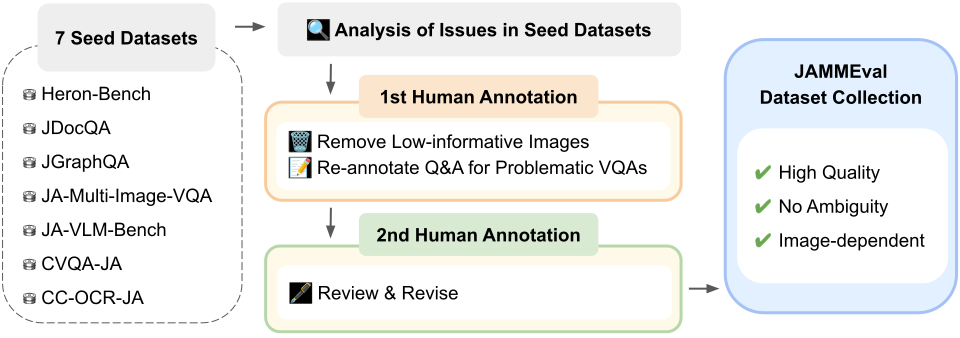
This allows us to base development decisions, such as dataset ablations and hyperparameter tuning, on more reliable evaluations.
Jagle: A Large-Scale Japanese Multimodal Dataset
Large-scale, diverse data is essential for building a high-performing vision-language model. For Japanese, however, such post-training datasets had not been sufficiently developed.
We therefore built Jagle, the largest Japanese multimodal post-training dataset, with about 9.2 million examples.
Jagle integrates diverse data sources such as the following and converts them into VQA format:
- Image-text pair data
- Single-image data
- PDF documents
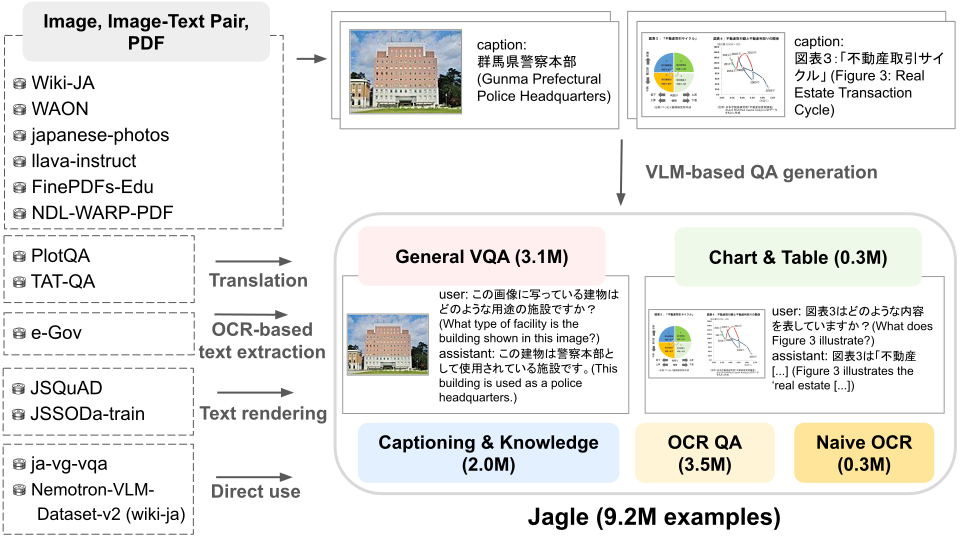
For example, we use data sources such as:
- WAON, a Japanese image-text pair dataset
- FinePDFs-Edu, a large-scale PDF corpus
Model Training
Building on these results, we trained LLM-jp-4-VL-9B-beta.
Model Architecture
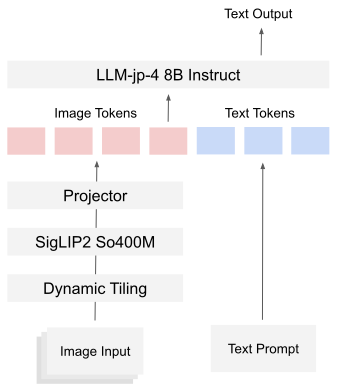
The model consists of the following components:
- LLM: llm-jp/llm-jp-4-8b-instruct (8.6B)
- Image encoder: google/siglip2-so400m-patch16-512 (0.4B)
- Projector: 2-layer MLP
Training Datasets
For training, we used the following data, about 33.4M examples in total across Japanese and English:
- Japanese: llm-jp/Jagle (9.2M examples)
- English: HuggingFaceM4/FineVision (24.2M examples)
Evaluation
The results on Japanese tasks are shown below. For evaluation, we used simple-evals-mm, a VLM evaluation library we developed.
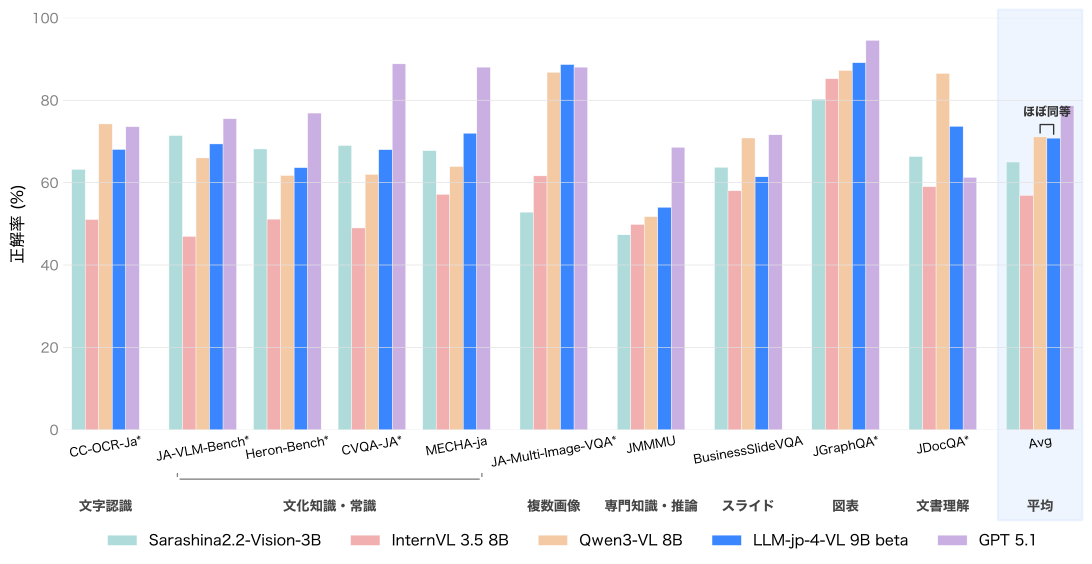
With about 180B tokens of multimodal post-training, LLM-jp-4-VL-9B-beta achieves average performance on par with Qwen3-VL-8B (about 2T tokens) using less than one-tenth of the training data.
Example Model Outputs
Here are some example outputs from LLM-jp-4-VL-9B-beta.
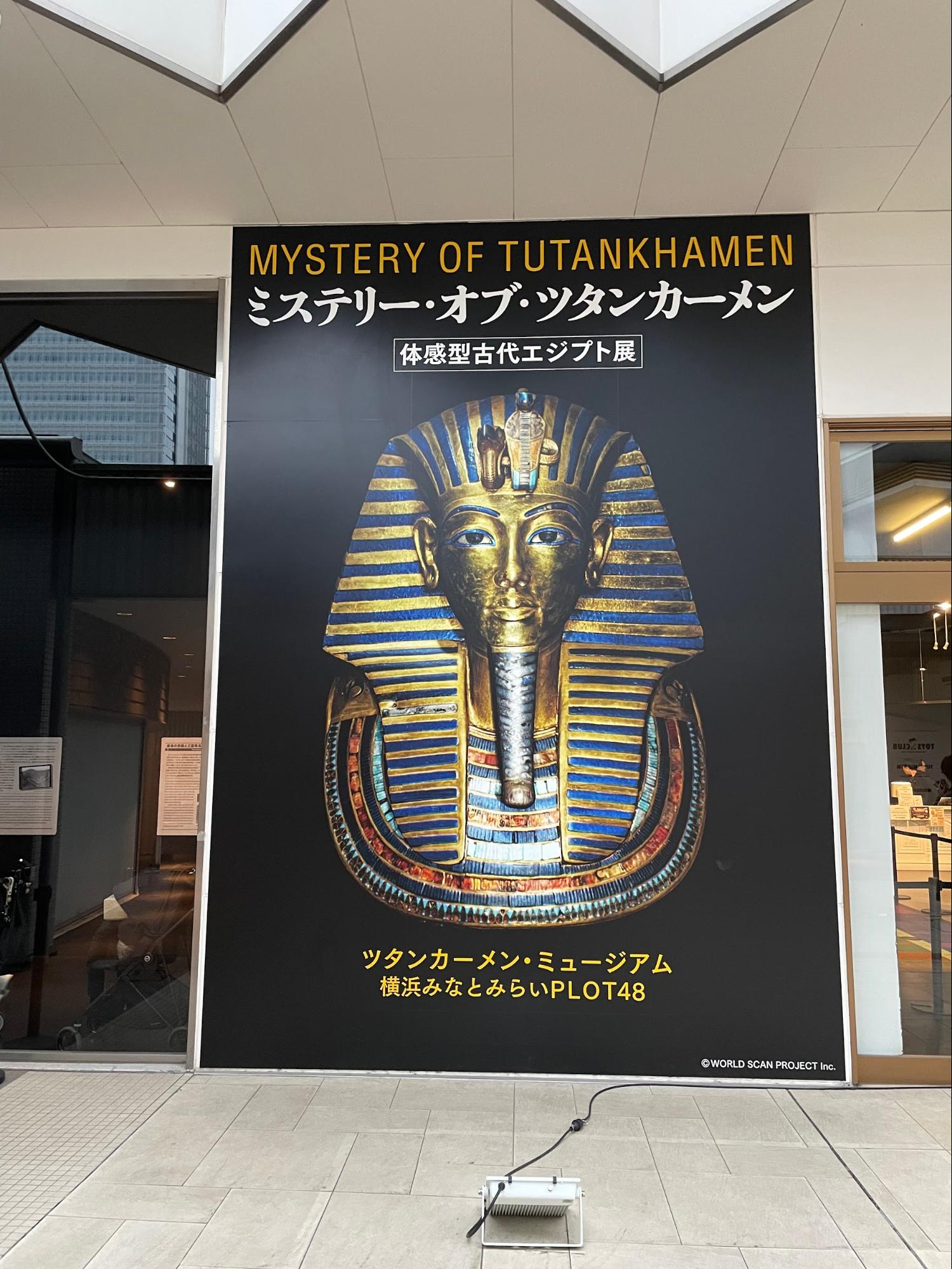
Question: 画像に含まれる文字を全て抽出してください (Extract all the text in the image.)
Model output:
"MYSTERY OF TUTANKHAMEN
ミステリー・オブ・ツタンカーメン
体感型古代エジプト展
ツタンカーメン・ミュージアム
横浜みなとみらいPLOT48
©WORLD SCAN PROJECT Inc."
The model accurately extracts the text in the image.
Conclusion
LLM-jp-4-VL-9B-beta is available on Hugging Face. Please give it a try.
For detailed experimental settings and analyses of the model, see the official LLM-jp tech blog.